

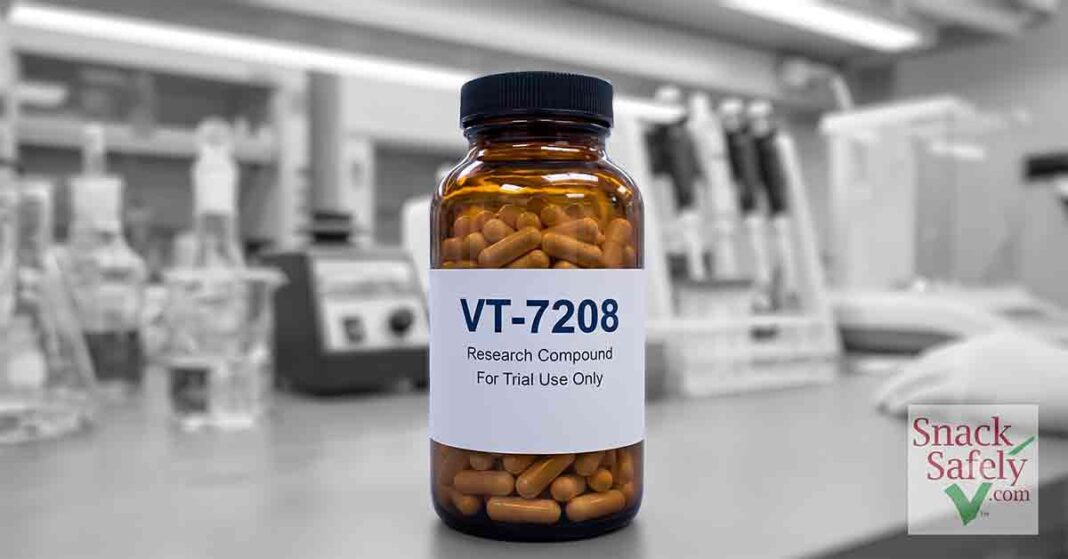
Food allergy treatment is attracting growing attention from the pharmaceutical industry as researchers look beyond strict avoidance and emergency medications toward therapies that could prevent reactions or reduce their severity. The field now includes injectable biologics, oral, sublingual, and skin-based immunotherapies, and experimental drugs designed to interrupt the immune pathways that drive allergic responses. One of the latest candidates to draw interest is VT-7208, an oral medication being developed not only for food allergy but also for chronic hives and multiple sclerosis.
To understand how VT-7208 works, you have to dive deep into the immune system. Inside immune cells like B cells and mast cells, is a signaling protein called Bruton’s tyrosine kinase, or BTK. BTK helps activate immune responses, but in some allergic, autoimmune, and neuroinflammatory diseases, BTK-related pathways may contribute to excessive or inappropriate inflammation.
VT-7208 is a next-generation BTK inhibitor designed to block those signals. It forms a bond with BTK, disabling the protein until cells produce a replacement. Early Phase 1 findings reportedly showed sustained target engagement at relatively low once-daily doses, although larger studies are needed to determine the most effective dose.
The drug was also designed to be highly selective for BTK, limiting its effect on unrelated enzymes. The company believes this could reduce the risk of liver toxicity and other side effects associated with some earlier BTK inhibitors, but that potential advantage has not yet been confirmed in larger clinical trials.
One of VT-7208’s most notable features is its ability to enter the central nervous system. Early testing reportedly detected the drug in both the bloodstream and cerebrospinal fluid, suggesting that it can reach immune pathways inside and outside the brain and spinal cord.
That gives researchers the opportunity to study VT-7208 across several conditions. It is being developed for severe food allergy and chronic spontaneous urticaria, commonly known as chronic hives, while its central nervous system penetration also makes it a candidate for relapsing multiple sclerosis. However, the drug has not yet been shown to improve symptoms or protect nerve function in any of these diseases.
Processa Pharmaceuticals recently acquired Vidya Therapeutics, VT-7208’s original developer, making the drug the lead asset in its clinical pipeline. The company also announced financing expected to provide approximately $200 million in gross proceeds and support Phase 2 development into 2029.
Phase 2 studies in food allergy and chronic spontaneous urticaria are expected to begin in the second half of 2026, followed by a relapsing multiple sclerosis trial in the first half of 2027.
VT-7208 remains an experimental drug. Phase 1 testing provided preliminary evidence regarding safety, drug exposure, central nervous system penetration, and BTK target engagement, but it did not establish clinical effectiveness. Upcoming studies will determine whether those early findings translate into meaningful benefits for patients, but Processa Pharma is betting hundreds of millions that it will.
- Caldera, Vidya add to recent flurry of biotech mergers — Biopharma Dive
- PROCESSA PHARMACEUTICALS, INC. ANNOUNCES ACQUISITION OF VIDYA THERAPEUTICS, INC. AND APPROXIMATELY $200 MILLION CONCURRENT PRIVATE PLACEMENT TO ADVANCE BTK INHIBITOR, VT-7208, IN MULTIPLE DISEASE AREAS — Stock Titan
- Processa acquires Vidya for potential BTK inhibitor rival to Novartis’ Rhapsido — Fierce Biotech