

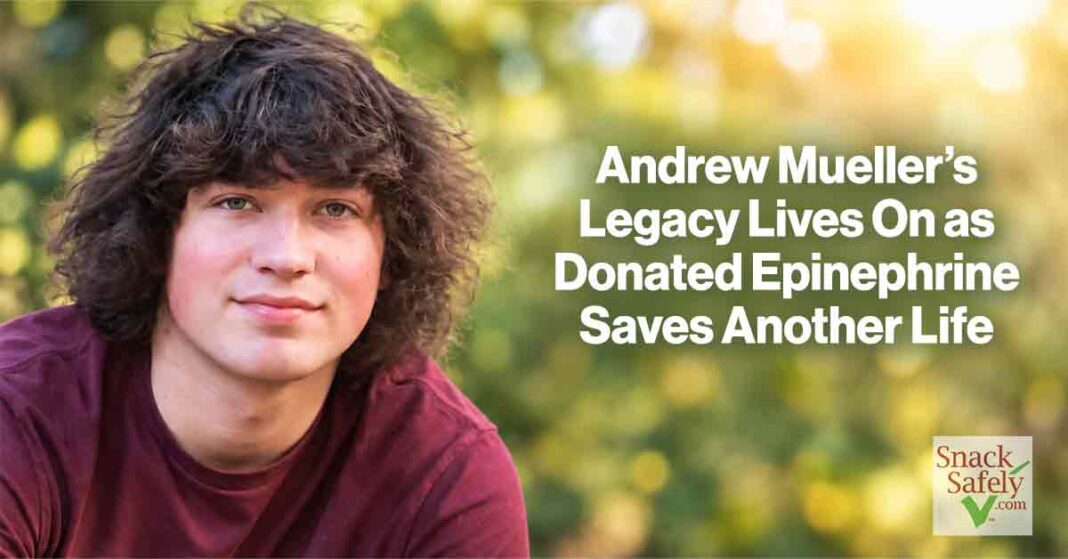
A Wisconsin family’s mission born from unimaginable loss is once again being credited with saving a life. Just six weeks after deputies with the Iowa County Sheriff’s Office were equipped with epinephrine auto-injectors funded by the Andrew Mueller Memorial Foundation, one of those devices was used to treat a woman suffering a rapidly progressing allergic reaction following an insect sting. The rescue provides another powerful example of why the Mueller family has worked to put life-saving epinephrine into the hands of first responders across Wisconsin.
The foundation was established following the death of 20-year-old Andrew Mueller, who suffered a fatal reaction to an undiagnosed peanut allergy in November 2024. When his family called 911, law enforcement officers arrived before paramedics but did not carry epinephrine, the first-line treatment for anaphylaxis. Andrew’s parents, Mark and Crista Mueller, subsequently began fundraising to provide auto-injectors to police officers and sheriff’s deputies, initially focusing their efforts on Wood County. Their work has since expanded dramatically, with the foundation providing funding for epinephrine in 11 Wisconsin counties.
That expansion proved critical this past weekend in Iowa County. A woman reported being stung twice by what she described as a black wasp and initially developed hives before her condition rapidly deteriorated and she began having difficulty breathing. An Iowa County sheriff’s deputy arrived carrying one of the recently supplied auto-injectors and administered the first dose of epinephrine. “With an allergic reaction, you have minutes, and that’s what happened this weekend we had minutes, and fortunately our deputy was in the right spot at the right time,” said Iowa County Sheriff Michael Peterson.
For Mark Mueller, the rescue is bittersweet confirmation that the foundation created in his son’s memory is accomplishing precisely what his family hoped it would. “That’s the ultimate goal here, to make sure that nobody has to go through what we just went through,” he said. The Iowa County rescue is not the first attributed to the initiative. Following the foundation’s earlier effort to equip first responders in Wood County, Mueller reported that donated epinephrine was administered during a 911 call in Wisconsin Rapids, saving the life of a 28-year-old. Now, he says, the devices are being called upon with striking frequency: “To hear how many epi-pens have been used already, it’s very gratifying to know that we’re saving lives.”
The Muellers have also taken their campaign to the Wisconsin State Capitol. In October 2025, Mark and Crista traveled to Madison and worked alongside Representative Scott Krug and Senator Patrick Testin in support of legislation that would mandate epinephrine auto-injector training and availability for first responders statewide. Speaking to legislators about the circumstances surrounding Andrew’s death, Mark issued an urgent appeal: “We urge you to act now so no parents stand where we are standing today.”
During that effort, Mueller stressed that providing epinephrine fits naturally with the life-saving role first responders already perform. “That’s what this legislation can do. It can save lives. Approximately one in 13 children have food allergies. Epinephrine is a first-line treatment for anaphylaxis. It can save life in seconds, but it’s only effective if it’s available,” he told lawmakers. Committee members raised questions at the time about funding, training, and disposal costs associated with a statewide mandate, while supporters argued that those concerns must be weighed against the ability to intervene when officers arrive before emergency medical personnel.
Senator Testin summed up the reasoning behind the proposal during the 2025 legislative effort: “I’d rather have the ability for first responders to have this tool at their disposal and hopefully not need it than need it and not have it.” The latest rescue in Iowa County puts that argument into stark relief: deputies had been carrying the devices for only six weeks before one was needed in a race against time. What began as one family’s response to tragedy has now expanded to 11 counties, with donated epinephrine already being used in emergencies—a legacy ensuring Andrew Mueller’s story continues to help protect others.