
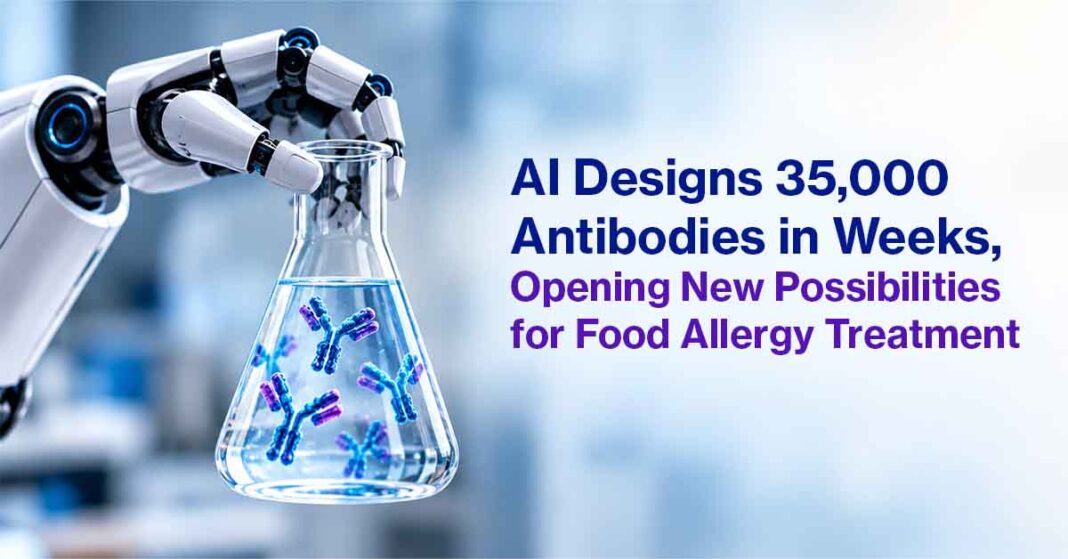
Artificial intelligence company Anthropic has used its Claude AI model to generate approximately 35,000 antibody designs in just one month as part of an effort to develop a new treatment for severe food allergies. The project highlights how artificial intelligence could dramatically accelerate drug discovery, potentially shortening research that once took months to just weeks.
Working with biotechnology firm Divergence Labs, Anthropic is exploring a new way to interfere with immunoglobulin E (IgE), an antibody that plays a central role in triggering allergic reactions. When someone with a food allergy encounters an allergen, IgE attached to certain immune cells can set off a chain reaction that releases chemicals responsible for symptoms ranging from hives and swelling to life-threatening anaphylaxis.
The experimental approach aims to go beyond existing treatments such as Xolair (omalizumab), which primarily works by binding to free-floating IgE in the bloodstream and preventing it from attaching to immune cells. Researchers hope to develop an antibody that can also detach IgE already bound to those cells, potentially reducing their ability to trigger allergic reactions. Although Xolair can also dislodge some cell-bound IgE under laboratory conditions, doing so requires concentrations that are not practical for patients.
Using Claude, researchers generated thousands of potential antibody designs and tested selected candidates in the laboratory. Of 57 designs evaluated for their ability to bind IgE, three showed promising activity. In a separate group of 91 designs tested for their ability to dislodge IgE, 20 demonstrated that capability. Notably, three of those candidates appeared more effective than Xolair at removing bound IgE under the laboratory conditions tested.
The results are encouraging, but significant challenges remain. Researchers must now combine the desired properties into a single antibody and determine whether it can safely detach IgE without activating immune cells and potentially triggering the very allergic reactions it is intended to prevent. No treatment resulting from this research has been tested in humans, and its ability to prevent allergic reactions remains unknown.
One of the most striking aspects of the project is its speed. Divergence Labs reported reaching initial experimental results in approximately three to four and a half weeks, compared with as long as nine months for similar projects using conventional methods. While faster discovery does not guarantee a successful medication, it could allow scientists to evaluate more potential treatments in considerably less time.
The food allergy initiative is part of Anthropic’s broader effort to incorporate artificial intelligence throughout pharmaceutical research and development. The company has announced partnerships with six healthcare organizations and is pursuing additional research into rare diseases, including childhood forms of muscular dystrophy. Rather than limiting Claude to generating molecular designs, Anthropic hopes to apply the technology to manufacturing, regulatory reviews, and clinical trial planning.
In another project, Anthropic collaborated with Generate Biomedicines to improve CAR T-cell therapies, which use genetically modified immune cells to attack cancer. Claude helped design a genetic component approximately 70 percent shorter than a conventional version. In laboratory experiments, the modified cells produced roughly 10 times more cancer-targeting receptors and demonstrated improved ability to kill solid tumor cells. These findings remain experimental and have not established improved outcomes in patients.
Claude also demonstrated potential for reducing the administrative burden associated with drug manufacturing. Working with biotechnology company Enveda, the AI reviewed 1,061 pages of manufacturing documentation, identifying all 11 discrepancies previously flagged by human reviewers across multiple runs and detecting seven additional potential issues during a timed evaluation. The process reduced review time by approximately 89 percent, from 25 hours to less than three hours.
Anthropic is also collaborating with Bristol Myers Squibb on evaluating clinical trial feasibility and design, with plans to expand that work in 2027. The company sees these projects as early steps toward using artificial intelligence across the pharmaceutical development process, stating, “We plan to scale this work up substantially from here.”
For people living with food allergies, the antibody research offers an intriguing possibility: a future treatment that could address IgE already attached to immune cells rather than primarily preventing additional IgE from binding. However, the findings are preliminary, and researchers must still demonstrate that such a treatment is safe and effective before it could advance into clinical trials.
For now, existing food allergy management strategies remain essential, including allergen avoidance, prescribed treatments, and immediate use of epinephrine when anaphylaxis occurs. The real breakthrough demonstrated so far is not a new allergy medication, but the possibility that artificial intelligence could help researchers discover and evaluate promising treatments far more quickly than before.