
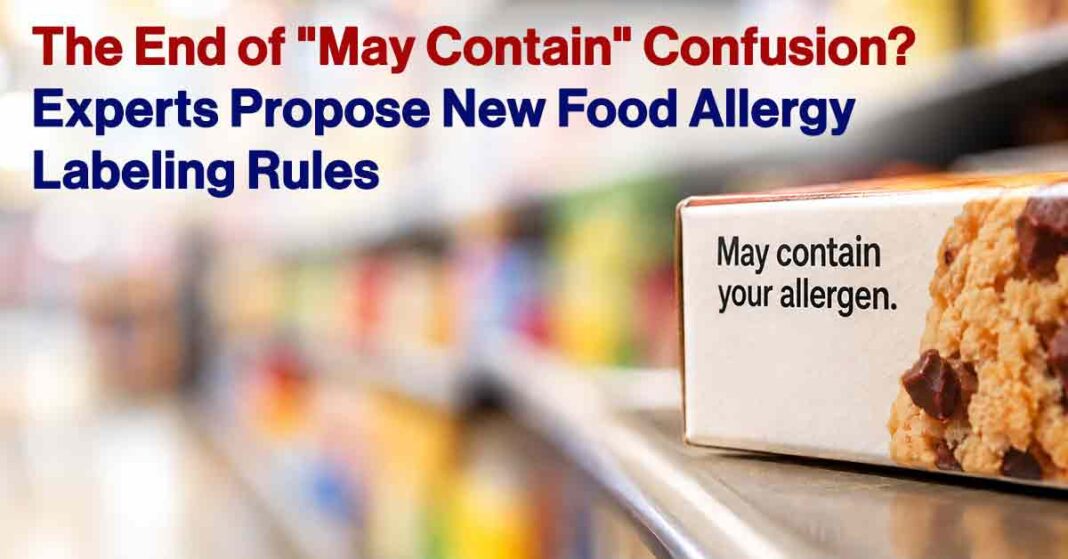
Food labels warning that a product “may contain” peanuts, milk, or other allergens are a familiar sight, but they often leave shoppers guessing. Because these warnings are largely voluntary and unregulated, food companies sometimes use them to protect themselves from lawsuits, even when the likelihood of contamination is low. Now, an international panel of 35 allergy specialists, scientists, and patient advocates representing 21 countries, convened by the World Allergy Organization (WAO), is calling for an overhaul that would replace today’s confusing system with consistent, science-based rules.
Today, shoppers face a confusing mix of precautionary allergen labeling phrases like “may contain,” “made in a facility with,” and “may contain traces.” The panel recommends replacing these variations with a single, straightforward statement: “May contain [allergen].” More importantly, manufacturers should not use these warnings simply as a precaution against lawsuits. Instead, companies should conduct formal risk assessments to determine whether unintended allergen contamination could expose consumers to amounts exceeding a scientifically established threshold. Warnings would generally be required only when that threshold could be exceeded.
To determine when a warning is necessary, the panel recommends using a scientific threshold known as ED05 (eliciting dose 5%). This represents the amount of allergenic protein estimated to trigger a reaction in approximately 5% of people with that particular allergy. The amount varies by allergen. For example, the reference dose is 2 milligrams of protein for peanuts, milk, and eggs, compared with 5 milligrams for wheat and fish. Rather than relying solely on concentrations measured in parts per million (ppm), the approach considers how much allergenic protein someone would actually consume in a typical serving. Importantly, ED05 is a statistical estimate, not a guarantee that the other 95% of allergic individuals will be safe.
The ED05 threshold represents a somewhat practical compromise between protecting consumers and avoiding unnecessary warnings. If standards are set too strictly, manufacturers may feel compelled to place warnings on many products that pose little risk to most allergic consumers. When warnings become commonplace, shoppers may begin ignoring them, undermining their usefulness. The panel believes an ED05-based approach could make warnings more meaningful while maintaining a scientifically informed level of protection. However, the experts could not agree on how manufacturers should communicate the remaining risk to particularly sensitive consumers when allergen exposure falls below the warning threshold. Under the proposed system, a product without a “may contain” warning would not necessarily be safe for everyone with that allergy.
The experts also took a clear stance on specialty food claims. If a package says a product is “free from” a specific allergen, 97% of the panel agreed that it should contain no detectable amount of that allergen, including accidental traces. Similarly, 80% supported changing the standard for “gluten-free” to require no detectable gluten, rather than allowing the small amounts currently permitted under regulations that set a limit of 20 parts per million. The panel also supported eliminating precautionary warnings for milk, eggs, and other animal-derived allergens on products labeled vegan. However, a vegan label does not guarantee that a product is free from accidental milk or egg contamination, so people with these allergies should not automatically assume vegan foods are safe.
To encourage manufacturers to adopt these science-based standards, the panel also addressed legal liability. Experts agreed that food companies demonstrating compliance with applicable food safety regulations should not be held legally responsible for allergic reactions caused by unintended allergen contamination. The goal is to reduce the incentive for manufacturers to place warnings on products simply to protect themselves from lawsuits. Instead, companies would have greater reason to conduct meaningful risk assessments and use warnings only when justified. These liability protections, like the other recommendations, are proposals rather than laws currently in effect.
Ultimately, the recommendations are intended to help shape international food safety regulations as authorities work toward more consistent rules for allergen warnings. As lead researcher Antonio Bognanni, MD, PhD, of McMaster University, and colleagues explained, precautionary labeling “should only be applied when a legally regulated risk assessment indicates the likelihood of unintended allergen presence, which can pose a risk to allergic individuals.” The proposed changes could make grocery shopping clearer and less frustrating for families managing food allergies, but they would not eliminate the risk of allergic reactions. For consumers, the challenge will be understanding what the new warnings mean—and, just as importantly, what the absence of a warning does not guarantee.
What do you think of these recommendations? Let us know in the comments section below. We will follow up in the coming days with our own take.