
When Anjo first appeared on SnackSafely in 2023, the startup was an ambitious idea backed by a pending patent and an urgent, deeply personal mission.
Founded by former Air Force pilots Tal Golan and Itamar Nocham alongside software architect Matan Lior, the project grew directly out of a parent’s worst nightmare: Nocham’s young daughter nearly died from a life-threatening allergic reaction at daycare after staff missed the early symptoms.
The founders set out to answer a simple but difficult question: could wearable technology help identify physiological changes associated with an allergic reaction early enough to alert someone who could intervene?
Three years later, Anjo has moved well beyond the prototype stage. Its technology is being studied at leading food allergy research centers across the country, and the company is now preparing to bring its first consumer product, AnjoConnect™, to families.
The initial feasibility study previewed on SnackSafely in 2023, led by Dr Naama Epstein from Dr Arnon Elizur’s team at Shamir Medical Center, is now complete and has been accepted for publication in The Journal of Allergy and Clinical Immunology: In Practice. The study found that Anjo’s wearable approach could identify meaningful physiological changes associated with reactions during oral food challenges, providing encouraging evidence for wearable monitoring as an additional tool for identifying changes associated with allergic reactions.
A major step in Anjo’s development came through its partnership with Samsung. By joining Samsung’s Health SDK partner program, Anjo gained the ability to deploy its proprietary software on Galaxy Watch hardware rather than developing a wearable from scratch. The integration has since been showcased at major health technology events including HLTH and the Healthcare Information and Management Systems Society’s HIMSS Global Health Conference & Exhibition.
Clinical research deployment has followed. Today, Anjo’s proprietary software platform is deployed across a dozen academic institutions and private allergy practices.
At Mount Sinai, Anjo is part of a dedicated collaborative study led by renowned food allergy researchers Dr Hugh Sampson and Dr Mary Grace Baker. As we previously reported, the research, supported by the Food Allergy Fund, is studying wearable physiological signals and digital biomarkers that could help identify allergic reactions earlier.
Anjo’s scientific work has also expanded through its participation in the Study of Oral Food Challenge Biomarkers, or SAFER, under the NIH-sponsored Consortium of Food Allergy Research (CoFAR). The study spans ten leading academic research centers across the country, including Johns Hopkins, Mount Sinai and Stanford, placing Anjo’s technology within one of the country’s major collaborative food allergy research efforts.
Anjo is also continuing its collaboration with the KeepSmilin4Abbie Foundation® to support the development of wearable technology aimed at detecting, and ultimately helping predict, anaphylaxis before visible symptoms appear. The company’s work has also received support from the Be Like Timmy Foundation as part of broader efforts within the food allergy community to advance technologies focused on earlier recognition of severe allergic reactions.
The company’s progress has also received non-dilutive support, including an award from the Consortium for Technology & Innovation in Pediatrics (CTIP), innovation funding from the State of New Jersey and support from the Food Allergy Fund, reflecting independent scientific review and confidence in the company’s early research and approach.
At the core of Anjo’s technology is the ability to monitor a watch wearer remotely. Earlier this year, Anjo demonstrated through its research platform the real-time detection of an anaphylactic reaction occurring in New York, while the company’s research team observed the reaction remotely from Israel, thousands of miles away. While further work is still needed to strengthen the technology and continue developing and validating its algorithms, the demonstration illustrated the potential for remote monitoring to help alert parents or caregivers when a child may be experiencing a severe allergic reaction or another acute event requiring immediate attention.
The platform is also being piloted as a beta product in private allergy practices, where clinicians are evaluating its dashboard and remote-monitoring capabilities during oral food challenges.
To help guide its continued development, Anjo has assembled a clinical advisory team that includes allergy and intensive care specialists Dr Michael Pistiner, Dr Sakina Bajowala, Dr Weily Soong and Dr Benjamin Matthews.
From Clinical Research to Families
Anjo is now preparing for the next stage: bringing part of that connected platform directly to families.
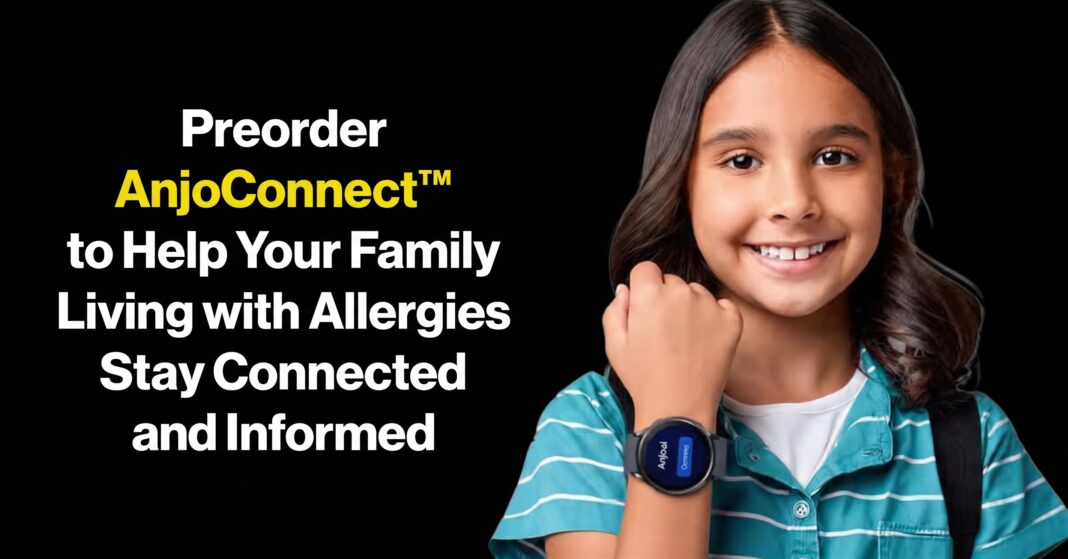
The company’s first consumer offering, AnjoConnect™, is designed to help parents and caregivers remain connected with a child or family member managing food allergies, particularly when they are apart.
Using Anjo’s software running on a Samsung Galaxy Watch, AnjoConnect™ provides continuous wellness monitoring and remote connectivity between the watch wearer and designated caregivers. Parents or caregivers can view the wearer’s biometrics at any time, even when they are apart, while the platform is being designed to include wellness-baseline alerts and simple check-in and messaging capabilities that can be especially useful for younger children.
Importantly, AnjoConnect™ is not a medical device and does not diagnose, predict or detect an allergic reaction or anaphylaxis. Its alerts are wellness-based and are not intended to provide medical information or replace established food allergy precautions, supervision or access to epinephrine.
The distinction is important because Anjo is developing the platform in two stages.
AnjoConnect™ is the company’s consumer connectivity and wellness product.
AnjoProtect™, now in development, is intended to add regulated medical capabilities designed specifically around the detection of allergic reactions. Those capabilities will require regulatory review before they can be made available.
The company says families who begin using AnjoConnect™ will not need to replace their wearable to access AnjoProtect™ when the medical product receives the necessary regulatory authorization. The additional capabilities are expected to be delivered through software updates.
AnjoConnect™ uses Anjo’s proprietary software and user interface on Samsung Galaxy Watch hardware and is designed to connect with both iPhone and Android smartphones.
For Anjo, it represents the first opportunity to move technology developed through years of food allergy research out of the clinic and into the daily lives of the families it was originally created to help.
AnjoConnect™ is available now for pre-order on the company’s website. The company is targeting first customer shipments in May 2027. To learn more, visit anjo.ai.
Author’s Note: SnackSafely received no compensation for this article and holds no financial stake in the company. We simply support Anjo’s mission to help safeguard children with food allergies and offer their parents peace of mind.