
For children living with severe food allergies, quick access to emergency medication at school can mean the difference between life and death. A nationwide survey of school nurses, presented at the 2026 Annual Scientific Meeting of the American College of Allergy, Asthma and Immunology (ACAAI), examined how K-12 schools store and manage epinephrine. The findings suggest that keeping general-use, or “stock,” epinephrine on campus provides an important safety advantage, although many schools continue to require families to supply individual devices for their children.
Epinephrine is the first-line treatment for anaphylaxis, a severe, potentially life-threatening allergic reaction. Although only 10 states legally mandate that schools maintain an unassigned supply of the medication for emergencies, many schools across the country stock it voluntarily. Despite this additional safety measure, parents of children with diagnosed food allergies are often required to provide a dedicated personal epinephrine autoinjector at the beginning of each school year.
To evaluate how these policies play out in practice, researchers distributed a questionnaire to 1,847 school nurses nationwide between August and December 2025, receiving completed responses from 349 nurses, each representing an individual school. The data revealed that while 87% of participating schools maintained a stock supply of epinephrine, 74% also required families to provide a personal device for their child.
“Our findings show that having stock epinephrine available at school clearly improves student safety, since schools without it were far more likely to end up without a working device in an emergency,” explained Mahi Singh, MD, the study’s lead author and an ACAAI member. “At the same time, schools also often require students with a known food allergy to bring their own personal epinephrine device each year and leave it with the school nurse. That can be expensive for families and limit accessibility outside school hours compared to backpack storage.”
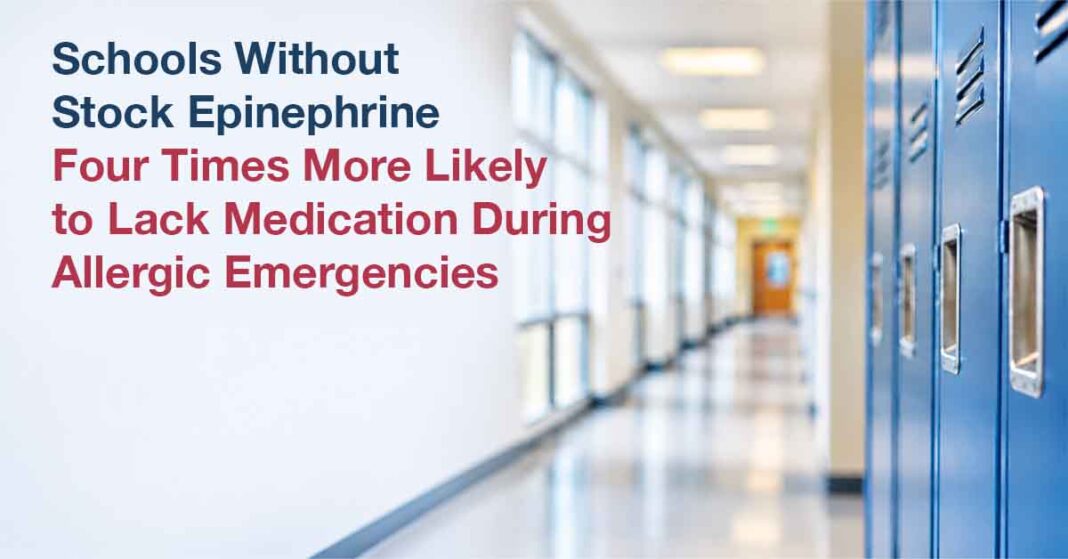
The survey also highlighted how infrequently epinephrine is administered in many schools. Nearly three-quarters of respondents (72%) reported no epinephrine administrations during the previous 12 months, while 97% reported never administering more than two epinephrine devices in a single day. However, 10% of nurses reported an allergic emergency in which epinephrine was unavailable when needed. Schools without stock supplies were 4.42 times more likely to report such an incident, underscoring the potential importance of maintaining emergency medication that is not assigned to a specific student.
Despite the relatively low frequency of epinephrine administration, school nurses expressed differing views about whether general-use supplies could replace individual prescriptions. Approximately three-quarters (74%) favored a “dual coverage” approach that combines stock epinephrine with student-provided devices, while 27% believed stock epinephrine alone would be sufficient. Singh indicated that the question of whether schools could safely rely on stock supplies without requiring personal devices warrants further investigation.
The researchers also raised concerns about the financial and logistical burden placed on families. Because epinephrine is administered relatively infrequently at school, many student-provided autoinjectors may go unused until they expire, requiring parents to replace medication that was never needed. Keeping a child’s personal device in the nurse’s office may also limit access to that medication outside school hours, compared with allowing students to carry their own emergency treatment.
The findings do have limitations. Only 349 of the 1,847 nurses surveyed responded, representing a response rate of approximately 19%. As a result, the participating schools may not reflect epinephrine policies and practices nationwide. The research also relied on nurses’ reported experiences rather than directly measuring whether different storage policies improved clinical outcomes.
Nevertheless, the study highlights an important opportunity to improve emergency preparedness in schools. Expanding access to stock epinephrine could help ensure that lifesaving medication is available when an allergic emergency occurs, while further research may help determine whether schools can reduce the financial and administrative burden on families without compromising student safety.
Does your child’s school have stock epinephrine on hand? Do they carry their own epinephrine in school? Share your school’s preparedness in the comments section.