
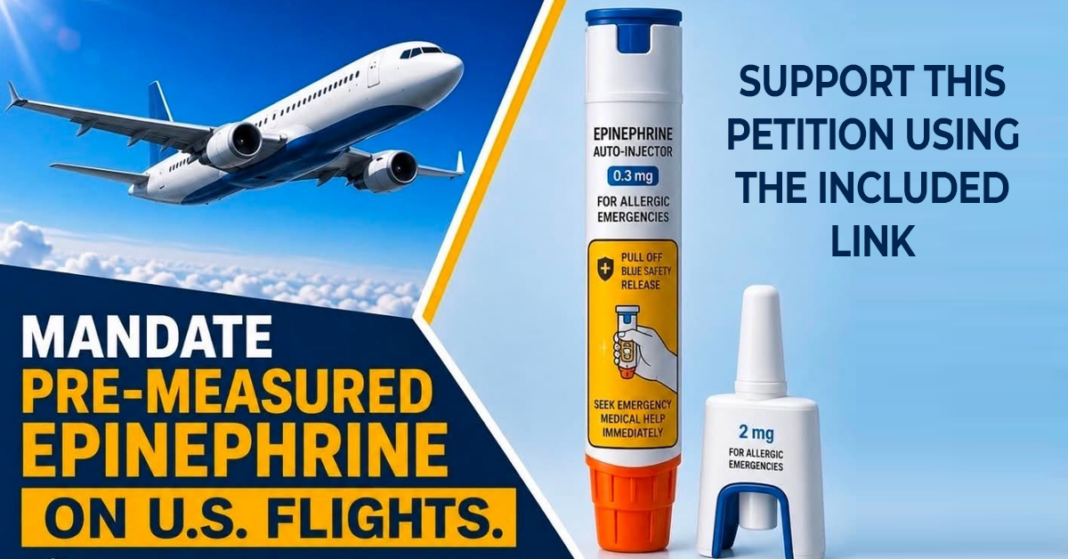
A new petition has been filed with the Federal Aviation Administration (FAA), urging the agency to require commercial US passenger airlines to stock life-saving epinephrine auto-injectors or nasal sprays in their emergency medical kits. Campaigners argue that without these easy-to-use devices, passengers suffering from severe allergic reactions risk dying at 35,000 feet. Epinephrine is the first-line treatment for anaphylaxis, rapidly reversing the effects of a severe allergic reaction before airway swelling and other symptoms become life-threatening.
Under current regulatory guidelines, the FAA only mandates that US airlines carry two single-dose vials of epinephrine. Crucially, these vials must be drawn up and administered intramuscularly with a syringe, a procedure that requires a qualified healthcare professional. Because most airlines do not train flight attendants to draw up and administer epinephrine from a vial, crews facing a severe allergic emergency often must rely on a qualified healthcare professional among the passengers who is willing to volunteer.
Advocates fear that the industry’s reliance on good fortune will inevitably run out if a passenger experiences a severe reaction without their own medication and no medical professionals are on board. To address this vulnerability, the Youth Food Allergy Policy Coalition submitted a new petition to the FAA. The organization is pressuring regulators to require emergency epinephrine devices—either auto-injectors or nasal sprays—which can be safely administered by non-medical personnel during an emergency.
In its formal petition, the advocacy group highlighted the impracticality of the current requirements in high-stress aviation environments. The coalition stated, “Syringes require significant training, and hygienic medical equipment is not readily available on aircraft to properly administer epinephrine doses. These conditions make epinephrine administration difficult and time-sensitive in real-world conditions, especially when an allergic reaction requires immediate intervention.”
To ensure adequate protection for all passengers, the Youth Food Allergy Policy Coalition is recommending that airlines carry a total of four doses of epinephrine on every aircraft. Their proposal specifies stocking two adult-dose devices and two pediatric-dose devices. Unlike traditional syringes, these auto-injectors or newer nasal sprays require minimal training to use, allowing flight attendants or nearby passengers to swiftly deliver a potentially life-saving dose.
The article also notes that cost remains a significant consideration. Brand-name EpiPens can retail for hundreds of dollars and expire periodically, while nasal sprays such as neffy carry similar replacement requirements despite offering double the shelf life. Critics argue that passengers with severe allergies should remain responsible for carrying their own prescribed medication, while advocates counter that onboard access to epinephrine provides an essential safety net when personal medication is unavailable or cannot be administered.
Political momentum on the issue has been building. In 2023, three US senators wrote to the FAA warning that only “good fortune” had prevented fatal allergic emergencies aboard commercial flights. Although that effort did not result in immediate regulatory changes, the FAA Reauthorization Act of 2024 requires the agency to review the contents of mandatory onboard medical kits. Specifically, the FAA must evaluate medications that can be “practicably administered” to treat anaphylaxis.
That review could ultimately pave the way for broader adoption of passenger-friendly emergency treatments. While regulators consider possible changes, some airlines have already moved ahead voluntarily. Southwest Airlines, for example, has begun stocking generic epinephrine auto-injectors in its emergency medical kits, providing a model that advocates hope other carriers—and eventually federal regulators—will follow.
For millions of Americans living with severe food allergies and other conditions that can trigger anaphylaxis, the outcome of the FAA’s review could have life-or-death consequences. Supporters of the petition argue that modern epinephrine delivery devices are simple, effective, and widely available, making them a logical addition to airline emergency preparedness efforts in an era when passengers increasingly expect rapid access to lifesaving medical interventions.
SnackSafely wholeheartedly endorses this effort to ensure life-saving epinephrine is always available on board in a form that can be administered without medical training. We applaud the Youth Food Allergy Policy Coalition for this undertaking and urge you to comment in support on the FAA site.
- Youth Food Allergy Policy Coalition – Exemption/Rulemaking — Youth Food Allergy Policy Coalition
- Campaigners Urge FAA to Force Airlines to Stock EpiPens in First Aid Kits Over Fears Allergy Sufferers Could Die at 35,000 Feet — Paddle Your Own Canoe