
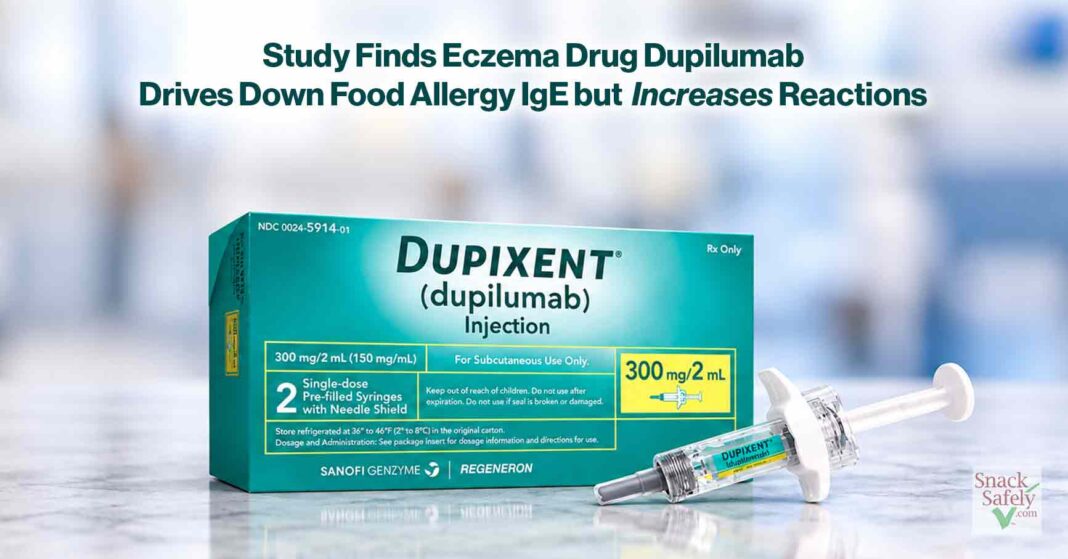
Children taking the medication dupilumab for conditions like eczema or asthma may show dramatic declines in allergy-related antibodies even though their food allergies persist. In a new study published in The Journal of Allergy and Clinical Immunology: In Practice, oral food challenges performed during or after dupilumab treatment resulted in more allergic reactions and a higher proportion of anaphylaxis than challenges performed before treatment, suggesting that falling antibody levels do not necessarily mean patients are becoming tolerant to their food allergens.
The findings come from a retrospective study by researchers at Ann & Robert H. Lurie Children’s Hospital of Chicago, published in The Journal of Allergy and Clinical Immunology: In Practice. Looking at medical records from 2014 to 2024, the team evaluated 129 pediatric patients with food allergies who were prescribed dupilumab, primarily to manage atopic dermatitis (eczema), eosinophilic esophagitis, or asthma. The median patient age was 13 years, and the median duration of dupilumab treatment was 25 months.
On paper, the medication appeared to be having a dramatic effect on allergy test results. Blood tests measuring food-specific IgE—the antibodies associated with allergic reactions—fell by a median of 49% to 89% after starting the drug. Levels declined by 49% for milk, 70% for peanut, 78% for egg, and 89% for soy. In routine allergy care, declining food-specific IgE may prompt an allergist to consider an oral food challenge to determine whether a patient has developed tolerance.
However, the real-world food challenges told a different story. Researchers reviewed 107 completed oral food challenges among 50 patients, including 67 performed before dupilumab treatment and 40 performed during or after treatment. Rather than demonstrating greater tolerance, challenges conducted during or after dupilumab were associated with more than twice the reaction rate seen in challenges performed before treatment: 47.5% versus 20.9%.
The difference extended to anaphylaxis. Anaphylaxis occurred during 25% of challenges performed during or after dupilumab treatment, compared with 9% before treatment. In adjusted analyses, dupilumab exposure was also associated with approximately threefold higher odds of falling into a higher reaction-severity category on two established grading systems: the Severity Grading Score for Acute Reactions (SGSAR) and the Bock/PRACTALL scale. Because this was a retrospective study comparing different challenges rather than a controlled trial, however, the results do not establish that dupilumab itself caused more frequent or severe allergic reactions.
Instead, the findings highlight an important disconnect between laboratory results and actual food tolerance. As the researchers noted, “Our findings suggest that despite decreases in food sIgE [specific IgE], dupilumab may not be efficacious in clinically desensitizing patients to food allergies and is likely not an effective food allergy therapeutic option. Clinicians should account for dupilumab treatment when interpreting patients’ food sIgE results and in deciding whether or not to offer OFCs.” In other words, a substantial decline in food-specific IgE while taking dupilumab should not by itself be interpreted as evidence that a patient’s food allergy is resolving.
The study has several important limitations. It was conducted at a single hospital, involved a relatively small number of patients undergoing food challenges, and did not use paired challenges that followed the same individuals before and after starting dupilumab. Allergists also determined how individual challenges were dosed and when they were stopped, meaning procedures varied among patients. Finally, many different foods were challenged, so the results may not apply equally to every allergen. Further research will be needed to determine precisely how dupilumab affects allergy testing and clinical food reactivity over time.
Do you or your child take Dupixent (dupilumab) and have a food allergy? Please share your experience in the comments section.