

American restaurants are suffering from an invisible financial leak, losing an estimated $12.6 billion annually due to ambiguous allergen disclosures. According to the Nutritics 2026 Allergy Dining Report, conducted in partnership with research platform Pollfish, food service operators risk forfeiting an average of $78 per table every time a customer with food allergies—or a dining party accommodating one—decides to eat elsewhere because menu information is vague, hard to navigate, or missing altogether.
The study was conducted by Nutritics, a provider of recipe, menu management, and food compliance software. Serving as the primary force behind the Allergen Disclosure for Dining Experiences (ADDE) Act Knowledge Hub, Nutritics provides hospitality businesses with digital tools to streamline nutritional labeling and allergen safety. To gauge real-world consumer behavior, Nutritics surveyed 1,000 U.S. adults in June 2026 whose dining choices are directly shaped by food allergies affecting themselves, family members, friends, or colleagues.
A primary takeaway from the report is that the vast majority of lost restaurant revenue occurs long before a customer steps foot through the door or places an order. Potential guests screen menus online or discuss options in group messages, opting to bypass establishments that do not offer explicit safety guarantees. As Stephen Nolan, CEO at Nutritics, explained:
For restaurant operators, one of the biggest losses are the guests who considered dining with them but ultimately chose another restaurant or ate at home. When diners can’t find the allergen information they need to feel confident about eating somewhere, many simply move on. Because those decisions happen before a reservation is made or an order is placed, restaurants often have no way of knowing how many allergy-affected guests they never converted.
The financial toll begins at individual dining tables but quickly scales into a massive macroeconomic issue across the industry. With approximately 33 million Americans living with food allergies, 41% of survey respondents reported avoiding specific restaurants more than half the time due to unclear allergen details, while 11% avoid them nearly every time. Factoring in average per-person spending ($10 to $34) and typical party sizes of two to four people, each missed party represents a $78 loss. Scaled across the national population of allergy-affected households, this pre-visit hesitation accounts for the $12.6 billion annual revenue leak.
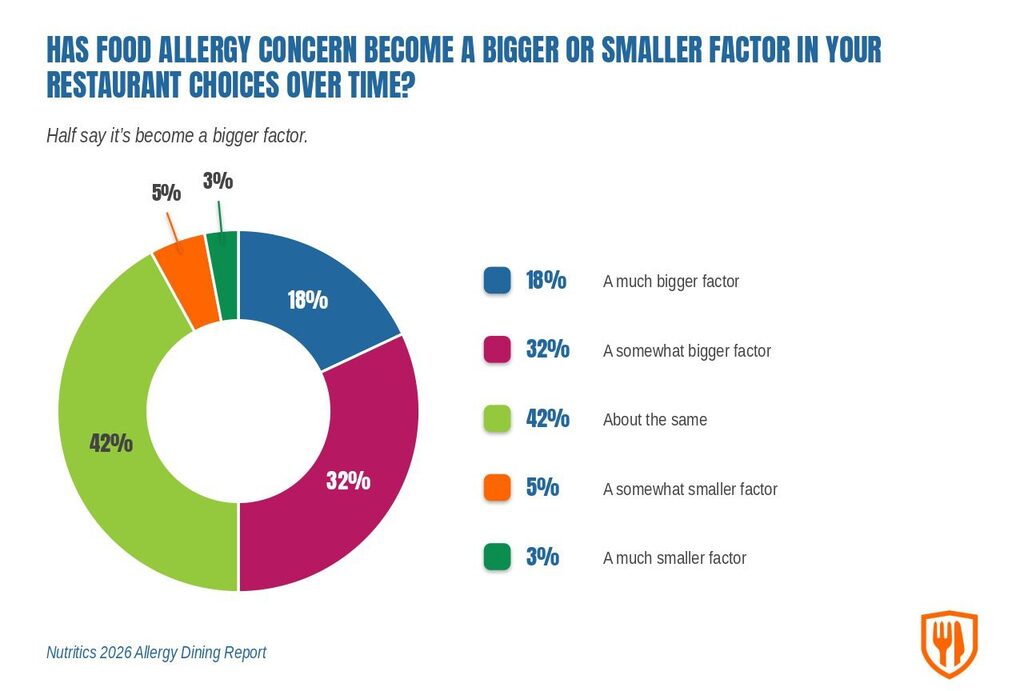
The findings highlight that food allergy considerations rarely affect just a single guest; instead, they dictate the choices of entire dining groups. A substantial 61% of survey respondents stated that their dining destinations are dictated by someone else’s allergy—such as a family member (18%), spouse (16%), friend (13%), or child (12%)—rather than their own. Furthermore, half of all participants noted that food allergy concerns have grown into a significantly larger factor in their dining decisions over time, meaning losing a single customer’s trust jeopardizes the revenue of an entire table.
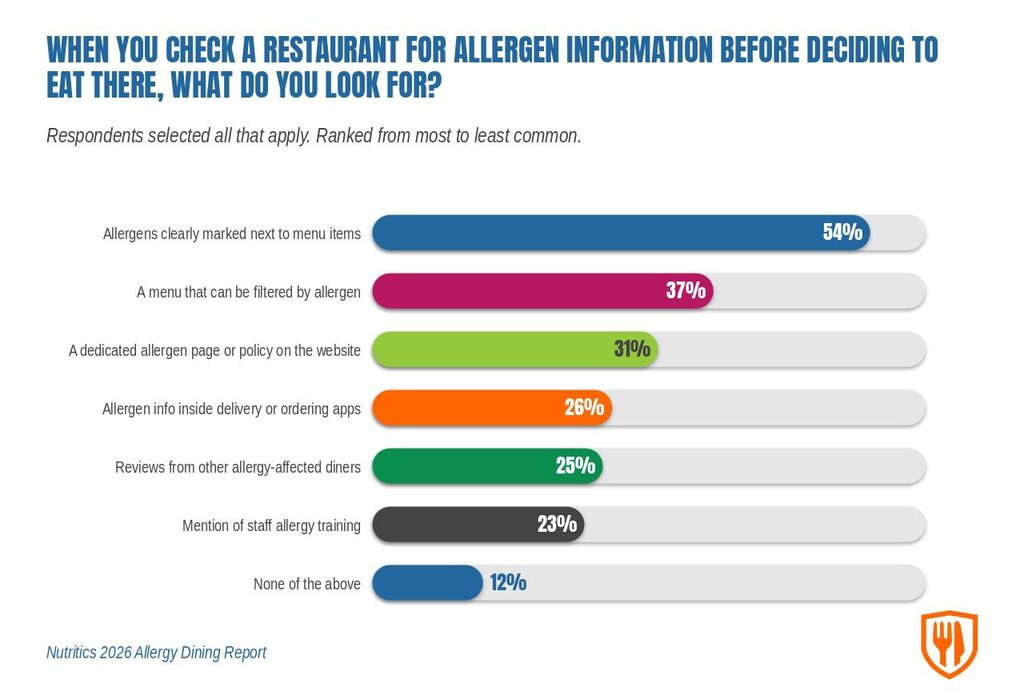
Before booking a table, modern consumers actively pre-screen establishments across various digital and physical touchpoints. Over half (54%) of diners look for explicit allergen labeling directly beside every menu item, 37% seek filterable online menus, 31% look for dedicated allergen web pages, and 26% evaluate delivery apps. When these touchpoints fail to provide clarity, patrons rarely call ahead for clarification—a staggering 95% of allergy-affected diners admit they have abandoned plans to visit a restaurant simply because clear allergen details were not easily accessible.
The imperative for clear communication is even more pronounced among families managing pediatric allergies. Parents whose dining decisions are governed by a child’s food allergy hold establishments to a notably higher standard of transparency: 61% require clear allergen markings next to menu items, and 45% look for interactive, filterable digital menus. Demonstrating the potential reward for accommodating these families, 78% of parents indicated they would dine out more frequently if restaurants consistently offered clear, trustworthy allergen documentation.
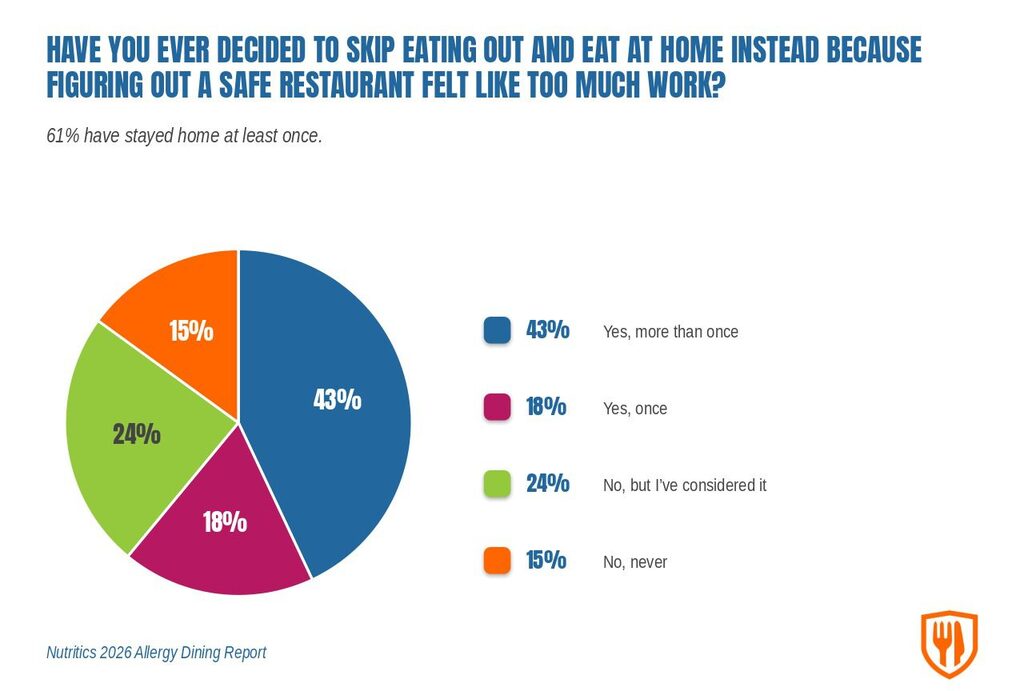
Relying on frontline staff to bridge the information gap often fails to reassure nervous guests. Only one in four diners (24%) feel fully confident that a server’s verbal assurance after checking with the kitchen represents a verified fact. Faced with this uncertainty, 61% of respondents have opted to stay home instead of navigating the stress of finding a safe restaurant, while 51% have actively switched allegiance to a new establishment offering superior allergen clarity. Conversely, brand loyalty runs deep for transparent businesses, as 52% of respondents have actively recommended specific restaurants to others based on trusted allergen practices.
Ultimately, the report emphasizes that allergen transparency is not merely a compliance burden, but a powerful growth opportunity for food service businesses. Clear labeling represents the single most effective way to build customer confidence, with 57% of respondents identifying items clearly marked with allergens as the top factor that increases their trust. By eliminating ambiguity from their menus, operators can plug a multi-billion-dollar revenue leak, win back hesitant parties, and build long-term loyalty among millions of American diners.