
The Federal Aviation Administration (FAA) is proposing a major overhaul of onboard medical equipment rules for US airlines operating under 14 CFR Part 121. The new framework would replace a fixed list of required supplies with broader performance standards, giving airlines more flexibility to choose what they stock. But it would not require epinephrine auto-injectors, an omission that will intensify longstanding concerns from food allergy advocates.
Federal requirements for onboard medical equipment date to 1949, when airlines were first required to carry basic first aid supplies. Emergency Medical Kits containing prescription drugs and diagnostic equipment became mandatory in 1986. The list was last updated in 2001, when the number of required items increased from 32 to 64. The FAA now says that rigid requirements make it difficult to keep pace with medical advances, drug shortages and discontinued products.
Under the proposal, airlines and medical-kit suppliers could select individual products as long as the kits are capable of addressing nine serious emergencies: cardiac events, airway problems, loss of consciousness, major bleeding, opioid overdose, hypoglycemia, gastrointestinal emergencies, anaphylaxis and childbirth. The FAA says the change would allow kits to reflect current medical guidance without requiring repeated regulatory revisions.
The proposal also responds to provisions in the FAA Reauthorization Act of 2024. Airlines would be required for the first time to carry opioid-reversal medication, such as Narcan or generic naloxone, and supplies capable of addressing unexpected childbirth.
The FAA adopted many recommendations from the Aerospace Medical Association but rejected its call to place certain medications in more accessible First Aid Kits. The agency said doing so would require additional medical training for flight attendants. First Aid Kits would therefore remain focused on injuries such as cuts, sprains, strains and fractures.
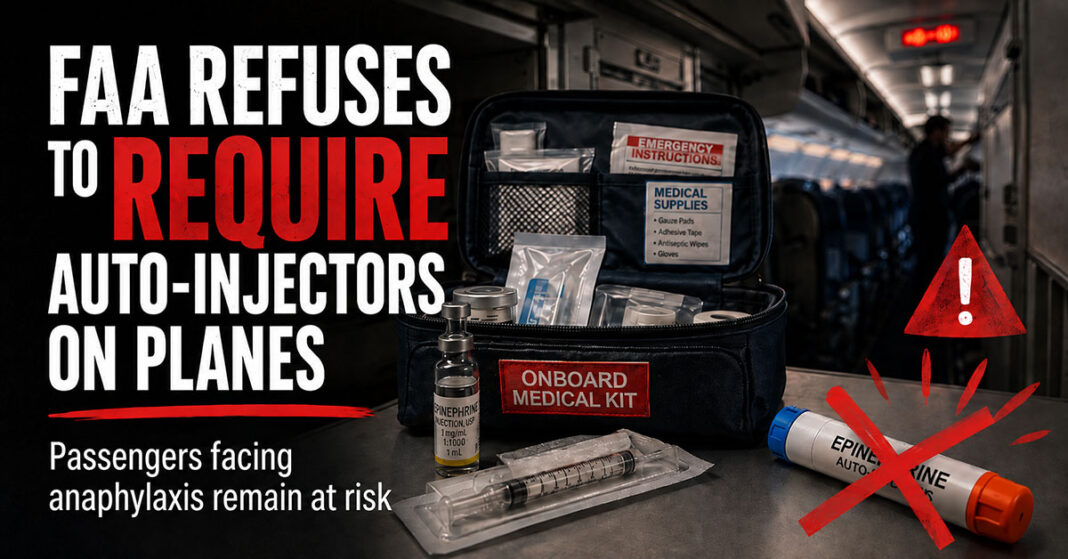
The most controversial provision concerns anaphylaxis. Airlines could continue relying on single-dose epinephrine ampules instead of auto-injectors. Ampules must be drawn into a syringe before use, generally requiring an onboard medical volunteer or a flight attendant acting under professional medical guidance. Although some carriers, including Southwest Airlines, voluntarily stock auto-injectors, the proposed rule would not make them mandatory.
The FAA argues that the performance-based system would help airlines adapt to shortages and medical advances while reducing costs. It estimates that First Aid Kit costs could fall by about 15%, though potential savings for Emergency Medical Kits have not been calculated.
We at SnackSafely find the FAA’s refusal to mandate epinephrine auto-injectors or nasal sprays reckless and out of touch with the grim reality of anaphylaxis at 30,000 feet. This is a clear example of the FAA prioritizing airline profits over passenger safety.