
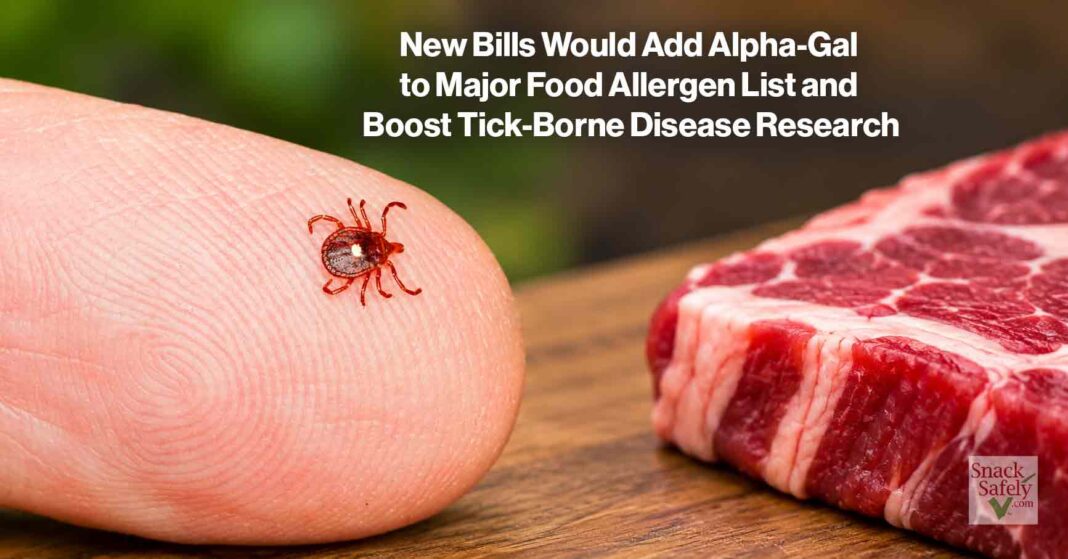
US Senator Mark Warner of Virginia has introduced two pieces of legislation aimed at strengthening the nation’s response to tick-borne diseases while providing new protections for people living with alpha-gal syndrome (AGS). The proposals would expand federal research and surveillance efforts and, in a significant change for the food allergy community, add alpha-gal to the federal list of major food allergens, requiring clearer labeling of packaged foods.
“Cases of alpha-gal syndrome are rapidly increasing in Virginia and across the country, and nearly everyone I meet has or knows someone whose life has been affected by this disease,” Warner said. “We must do more to understand, prevent, and treat AGS and other tick-borne diseases.” AGS is an allergy most commonly associated with the bite of the lone star tick and can cause potentially life-threatening reactions to alpha-gal, a carbohydrate found in most mammalian meat and in some mammal-derived products.
One of Warner’s proposals, the Strengthening Tick-borne disease Opposition and Prevention Through Investment in Collaboration, Knowledge, and Surveillance (STOP TICKS) Act, would reauthorize and expand the federal Tick-Borne Disease Working Group. It would also increase funding for Centers for Disease Control and Prevention grants supporting states and researchers working on vector-borne diseases, with the goal of improving prevention, research, surveillance and the federal response to illnesses and conditions associated with ticks.
The second proposal, the Alpha-Gal Allergen Inclusion Act, would have a more direct impact on people trying to manage AGS in everyday life. The legislation would add alpha-gal to the federal list of major food allergens, meaning packaged foods containing ingredients that fall under the new labeling requirement would have to clearly disclose the allergen. A companion bill has been introduced in the House by Rep Jeff Van Drew of New Jersey.
The labeling issue is particularly important because people with AGS may need to avoid mammalian-derived ingredients that are not always obvious from current food labels. “Reading a label should not require guesswork or a call to the manufacturer,” said Alpha-gal Foundation co-founders Candice Matthis and Debbie Nichols. They said clearer labeling would give people with AGS greater confidence when shopping, cooking and sharing meals. The proposal has attracted support from numerous allergy, tick-borne disease and medical organizations.
Researchers are also seeing evidence that AGS is becoming an increasingly important public health issue. Warner’s office cited research from Virginia Commonwealth University showing a 100-fold increase in positive alpha-gal antibody test results between 2013 and 2024. University of Virginia researchers Thomas Platts-Mills and Jeffrey Wilson welcomed Warner’s efforts to advance both scientific research and public education about the connection between tick bites and allergic reactions, calling AGS a “serious, potentially life-threatening allergy.”
For people living with alpha-gal syndrome, the two bills address different sides of the same problem: one seeks to improve the nation’s understanding, surveillance and prevention of tick-borne conditions, while the other focuses on making everyday food choices safer and easier. Whether the measures ultimately become law will depend on their progress through Congress, but their introduction puts both expanded tick-borne disease research and federal alpha-gal food labeling squarely before lawmakers.