
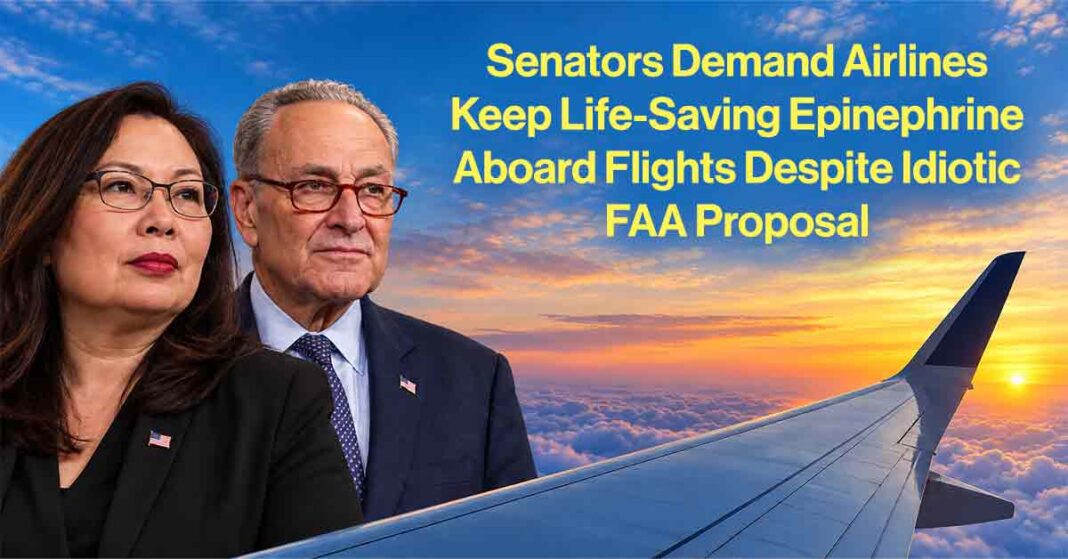
US Senator Tammy Duckworth and Senate Democratic Leader Chuck Schumer have called on every major US-based passenger airline to guarantee that emergency medical kits (EMKs) aboard their aircraft contain life-saving epinephrine in FDA-approved delivery methods designed for easy self-administration, such as auto-injectors or nasal sprays. The lawmakers’ intervention responds to concerns that passengers suffering severe allergic reactions at 35,000 feet may be left without immediate, accessible treatment.
The push follows an August 5, 2026, Federal Aviation Administration (FAA) Notice of Proposed Rulemaking titled “Improving Emergency Medical Kit Efficacy and Flexibility in Commercial Airline Operations.” Under the proposed changes, the agency would shift away from prescriptive medical kit mandates, granting carriers discretion to choose what medications to stock as long as kits are deemed “practical and sufficient” to address nine broad medical conditions. While current rules require two single-dose ampules or equivalents of epinephrine, epinephrine would no longer appear on a federally prescribed list of mandatory EMK contents. Instead, FAA guidance says treatment options for anaphylaxis “could include medication such as epinephrine.”
Duckworth and Schumer sharply criticized the proposed change, arguing that greater carrier discretion could lead to dangerous inconsistencies across the aviation sector. “The Trump Administration’s proposed rule will reduce public safety and trust when flying by increasing ambiguity, subjectivity and opacity with respect to EMK components,” the senators wrote. “There have already been reports of incomplete, outdated and unusable EMKs, with some physician passengers being forced to crowdsource medication from passengers. Further, airlines are not required to publicly or centrally report the real-time inventory and exact contents of their EMKs and have continued to operate under exemptions granted from the FAA for years.”
The lawmakers also argue that the proposed rule departs from recommendations made by the FAA’s own Onboard Medical Kits Working Group. Established under the FAA Reauthorization Act of 2024, the panel of aerospace medicine physicians, cabin safety specialists and researchers submitted a May 2025 report advising that kits support stabilizing basic life support for emergencies such as anaphylaxis, explicitly recommending either pre-measured auto-delivery devices or vial-drawn kits. Under the proposed rule, the existing exemption process would also be eliminated, allowing airlines greater flexibility to substitute or omit particular medications without seeking individual FAA exemptions.
To underscore the risks of relying on standard vials rather than easier-to-use delivery systems, the senators cited real-world incidents, including the case of an 18-year-old college student who suffered an in-flight allergic reaction in 2019 while crew members were unsure how to administer medication from the emergency kit. They also pointed to a case that same year in which a New York physician had to intervene during another in-flight emergency: “Even if an aircraft’s EMK contains a vial of epinephrine, the lack of an easily self-administered delivery system, such as an auto-injector, could make providing the medication dangerous for a layperson or even challenging for a trained medical doctor. This type of harrowing scenario occurred that same year, in 2019, when a prominent New York-based physician was forced to make split-second calculations to draw from a vial a safe, diluted fraction of the available cardiac arrest formulation of epinephrine to save the life of a young man having a severe allergic reaction.”
The lawmakers argued that accessible delivery methods are increasingly important given the prevalence of childhood food allergies, allergy-inducing tick-borne illnesses and the distribution of foods containing unlabeled allergens aboard flights. They highlighted a January 2026 incident aboard a Virgin Australia flight in which a passenger experiencing severe anaphylaxis required two successive doses of epinephrine. The first came from the passenger’s own auto-injector, while the second was supplied by another passenger because airline-provided epinephrine was unavailable. Duckworth and Schumer cited the incident as an example of why passengers should not have to depend on chance access to medication or medical personnel during an in-flight emergency.
In their formal letters to airline chief executives, Duckworth and Schumer gave carriers until Friday, September 25, 2026, to provide detailed information about their current onboard medical equipment and practices. The senators asked what forms and quantities of epinephrine airlines carry, whether carriers track in-flight anaphylaxis, whether they have sought FAA exemptions involving epinephrine or other EMK components, and how they would ensure kits remain consistent, reliable and up to date if the FAA adopts the proposed performance-based system.
The FAA’s plan to make epinephrine voluntary is patently unacceptable. Use this link from the Asthma and Allergy Foundation of America to tell the FDA to mandate easy-to-use epinephrine.