
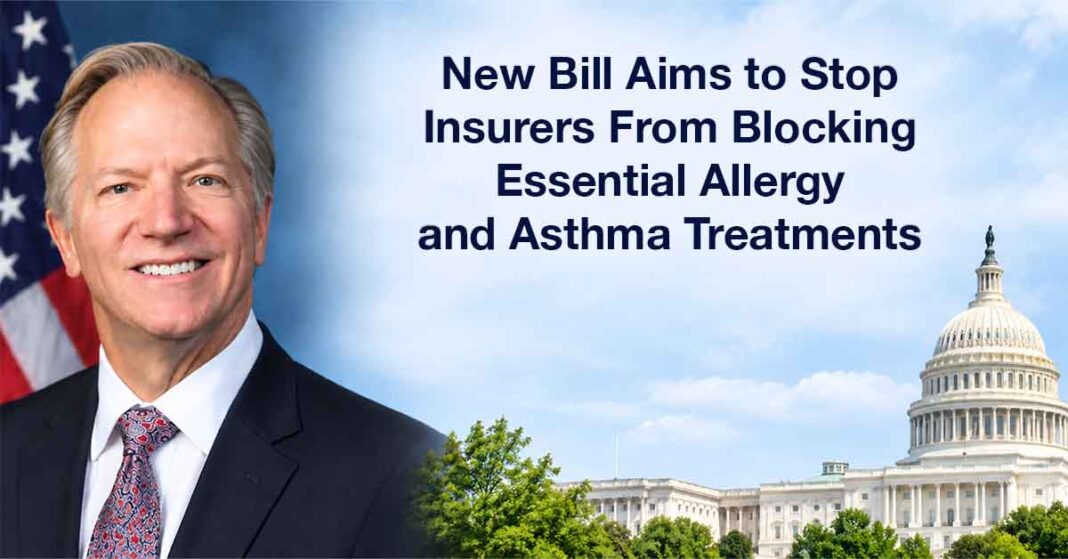
Federal lawmakers are taking steps to help people living with allergies and asthma access essential medical treatments without unnecessary insurance obstacles. On November 17, 2026, US Representative Bob Onder, MD, introduced the Allergy & Asthma Patient Protection (AAPP) Act in the House of Representatives. As a practicing allergist and the only allergist currently serving in Congress, Onder brings firsthand clinical experience to the effort to protect patients from insurance restrictions that can interfere with their care.
Rep Onder worked closely with the American College of Allergy, Asthma & Immunology (ACAAI), a leading professional medical organization, to develop the legislation. The bill seeks to address insurance policies and administrative practices that delay or interrupt treatment, particularly those involving reimbursement and other challenges specific to allergy and immunology care. By reducing these obstacles, supporters hope to allow physicians to spend more time treating patients and less time navigating insurance requirements.
A central focus of the proposed law is protecting reimbursement for essential services, particularly allergy immunotherapy. These treatments gradually help patients become less sensitive to certain allergens, reducing allergic symptoms and, in some cases, improving asthma control. According to the ACAAI, allergy immunotherapy benefits more than 2.6 million patients annually. Supporters of the legislation argue that insurance restrictions and reimbursement challenges can disrupt these treatments, potentially undermining patient care and increasing overall healthcare costs.
The ACAAI has strongly endorsed the legislation. “ACAAI strongly endorses the Allergy and Asthma Patient Protection Act,” said allergists David Stukus, MD, and Cherie Zachary, MD, who serve as the organization’s president and immediate past president, respectively. Their support reflects growing concern within the specialty that insurance restrictions and administrative requirements are making it more difficult for physicians to provide established, effective treatments.
The physicians also emphasized the widespread importance of maintaining access to allergy care. “Commercial insurers are increasingly restricting access to essential allergy and asthma treatments, including allergy immunotherapy, a safe and effective treatment that benefits more than 2.6 million patients annually,” they explained. They added, “We thank Representative Onder, the only allergist in Congress, for introducing this important legislation to protect patient access to care and help allergists deliver the treatments their patients need.”
Headquartered in Arlington Heights, Illinois, the ACAAI is a professional medical organization representing more than 6,500 allergist-immunologists and allied health professionals nationwide. The organization promotes improvements in patient care, medical education, research, and public health advocacy. Its physician members specialize in diagnosing and treating allergic conditions and asthma, administering immunotherapy, and helping patients manage their symptoms and improve their quality of life.
As the Allergy & Asthma Patient Protection Act begins its journey through Congress, its supporters hope the legislation will reduce administrative burdens, protect reimbursement for essential treatments, and help patients maintain access to ongoing allergy and asthma care. The ACAAI believes these improvements could lead to better health outcomes while lowering overall healthcare costs. Whether the bill achieves those goals will depend on its passage and implementation.