
For the more than 220 million people living with food allergies worldwide, daily meals often come with the constant stress of avoiding dangerous ingredients. An allergic reaction happens when the immune system mistakes an ordinary, harmless food protein for a threat and attacks it. Existing treatments such as oral immunotherapy (OIT) can help some patients become less sensitive to their triggers through repeated, carefully controlled exposure. However, these treatments can be time-consuming, cause uncomfortable side effects, and do not guarantee a permanent cure. As a result, many people rely primarily on carefully reading food labels and avoiding ingredients that could trigger dangerous reactions.
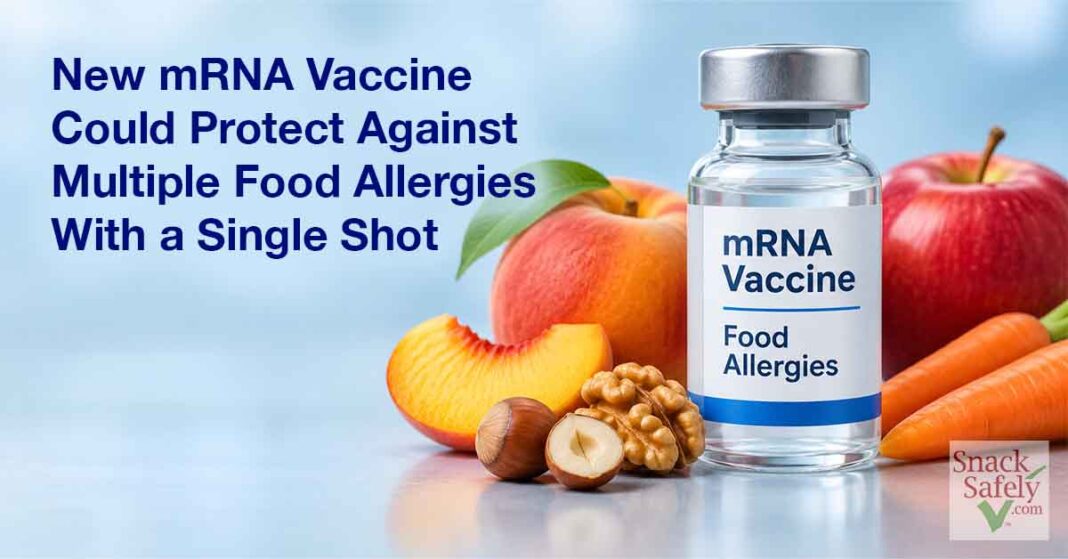
Researchers at the Technical University of Denmark (DTU) are working to change that reality with a new experimental mRNA vaccine designed to tackle several related food allergies simultaneously. Rather than exposing patients to actual food allergens, the vaccine uses a single synthetic allergen engineered to mimic the shared molecular traits of several related triggers, such as those found in peaches and certain nuts. “The idea is that if you are allergic to several different things, all of which have roughly the same molecular structure, we can take this structure and produce an artificial allergen, which we then incorporate into a vaccine,” explains DTU Bioengineering Associate Professor Esperanza Rivera de Torre.
Using the same mRNA technology popularized during the COVID-19 pandemic, the vaccine provides instructions that prompt the body to produce a specially designed allergen-like protein, stimulating the immune system to generate protective antibodies. Researchers hope these antibodies will eventually prevent related allergens from triggering dangerous reactions. “We use the mRNA as a Trojan horse: Instead of giving the patient the actual allergen and building up the body’s tolerance to it, we use the vaccine to give the body instructions on how to handle the allergen correctly, thereby avoiding an allergic reaction,” says Rivera de Torre, adding, “My hope is that patients will be able to eat whatever they like without having to check the ingredients list.”
Early testing, published in Nature Communications in February 2026, has yielded encouraging results. When the DTU team administered three doses of the vaccine to healthy mice at three-week intervals, the animals generated a strong protective antibody response against multiple targeted allergens. Allergic mice also experienced a substantial increase in these protective antibodies, with virtually no vaccine-related side effects observed. However, the tested doses did not provide complete protection against anaphylaxis, a potentially life-threatening allergic reaction. The findings represent an important proof of concept, but further research is needed to establish whether the vaccine can reliably prevent severe reactions.
To investigate how these findings might translate to people, the scientists conducted laboratory experiments using blood and cells from human allergy patients alongside protective antibodies generated by vaccinated mice. The tests showed that the mouse antibodies successfully inhibited allergic responses in the human samples. Although encouraging, these results do not establish that the vaccine can prevent allergic reactions in living humans. PhD student and lead study author Mark Møiniche notes the significance of the findings: “If you can induce such antibody responses in mice, then there is also a very good chance that you can do so in humans. And if they protect the mice against allergic reactions, then there is also a good chance that they will provide protection in humans.”
Backed by a new five million Danish kroner ($734,000) grant from the Lundbeck Foundation, the researchers are now fine-tuning the vaccine’s formulation. Specifically, they are refining its lipid-based components to influence how the immune system responds. “You can swap out different parts of the lipids, depending on how you want to tweak the immune system to elicit a specific response or perhaps avoid a particular response,” Møiniche explains. Alongside these adjustments, the team plans larger mouse studies to determine whether different doses and vaccination schedules can provide more complete protection, including against anaphylaxis.
While the current version of the vaccine targets related allergens particularly common in southern Europe that can cause cross-reactions to various fruits, the DTU team believes its approach could be adapted for other allergy groups. Researchers are already developing another synthetic allergen designed to protect against cross-reactive allergens found in apples, carrots, and hazelnuts. Ultimately, the scientists hope this next phase of research will generate the safety and effectiveness data needed to obtain approval for human clinical trials, potentially bringing a vaccine capable of protecting against multiple related food allergens closer to human testing.
- New mRNA vaccine steps closer to treating multiple food allergies — News-Medical.net
- An mRNA-delivered consensus allergen induces a neutralizing IgG response against food and pollen allergens — Nature Communications