

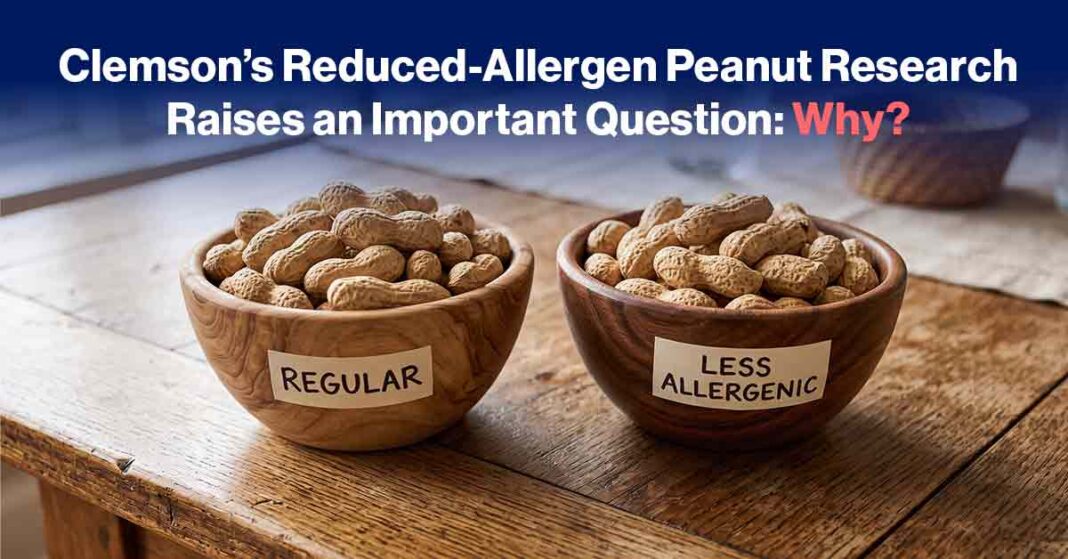
For millions of people living with severe food allergies, accidental exposure to even small amounts of peanuts can trigger life-threatening reactions. In an important advance toward mitigating this danger, agricultural scientists at Clemson University’s Pee Dee Research and Education Center in Florence, South Carolina, have identified naturally occurring peanut lines with markedly lower concentrations of several major allergenic proteins.
Peanut allergy affects an estimated 1% to 2% of the U.S. population and is a leading cause of severe food-induced allergic reactions, including anaphylaxis. Because managing the condition requires constant vigilance, scientists and agricultural breeders have sought to develop reduced-allergen peanut varieties to reduce the risks of accidental peanut exposure.
Published in the journal Functional & Integrative Genomics, the study focused on four major peanut allergens — Ara h1, Ara h2, Ara h3, and Ara h6. By screening 92 genetically diverse peanut lines, the research team discovered substantial variation in allergen levels, with specific lines showing reduced levels of one or more of these major allergenic proteins.
Using genetic analysis, the scientists identified chromosomal regions associated with the production and abundance of these allergenic proteins. “Peanut allergy isn’t just a medical issue,” said Sachin Rustgi, a molecular plant breeder who led the research team. “It affects everyday decisions for millions of people. Our goal is to understand the genetics behind allergenic proteins so we can give breeders the tools to develop safer peanut varieties.”
While the discovery marks an important milestone, reduced-allergen peanuts will not appear on grocery shelves immediately. Further research is needed to validate the genetic regions identified in the study and determine whether these traits can be reliably incorporated into commercially viable peanut varieties while maintaining desirable agricultural and food-quality characteristics. Researchers also see potential for future reduced-allergen peanuts to provide more consistent materials for oral immunotherapy (OIT) treatments.
Importantly, reduced-allergen does not mean allergy-safe: the researchers measured reductions in major allergenic proteins, not whether people with peanut allergies can safely consume these peanut lines. Further research would be necessary to determine whether reduced concentrations of these proteins translate into a clinically meaningful reduction in the risk or severity of allergic reactions.
The potential implications extend well beyond individual dietary safety, with possible benefits across the broader food and farming sectors. “For families managing peanut allergies, this offers hope,” said Gautam Saripalli, a co-researcher on the project. “For farmers, it could eventually create new market opportunities. For consumers around the world, it brings us one step closer to a future in which more people can enjoy the nutritional benefits of peanuts with less risk.”
The research could also hold economic promise for regional agriculture. In South Carolina alone, farmers harvested approximately 90,000 acres of peanuts in 2025, producing around 313 million pounds of the crop valued at nearly $65 million. Equipping growers with reduced-allergen varieties could eventually create new commercial opportunities while contributing to efforts to reduce the risks associated with accidental peanut exposure.
We at SnackSafely.com are skeptical that this research will ultimately provide a net benefit to the food allergy community and believe these resources might be better directed toward developing treatments and, ultimately, a cure for food allergy.
Even if reduced-allergen peanut varieties were successfully introduced, consumers would have no practical way to distinguish them from conventional peanuts once removed from their packaging, potentially creating confusion and a false sense of security that could increase the risk of accidental exposure. It also remains unclear whether reduced-allergen varieties would be as suitable or effective for use in oral immunotherapy (OIT), where carefully controlled allergen exposure is central to treatment.
What do you think? Is developing reduced-allergen peanuts a worthwhile avenue of research, or would these resources be better directed elsewhere? Let us know in the comments section.
- Clemson scientists identify reduced-allergen peanuts that could lead to safer foods, stronger crops — Clemson University
- Genetic regulation of major immunogenic protein accumulation in peanut seeds — Functional & Integrative Genomics





They could be useful in the reintroduction phase. I doubt if they would be a solution by themselves.
I have the same concern that the less allergenic peanut would look like the “regular” peanut and would cause confusion for people with food allergies