
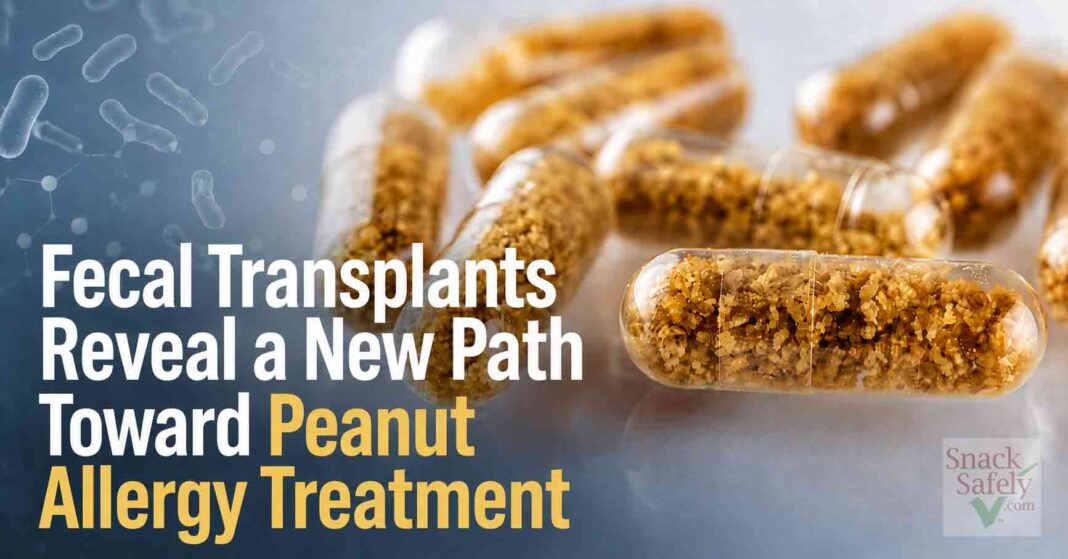
A pioneering study published in Science Translational Medicine is providing new insight into how fecal microbiota transplantation (FMT) may improve peanut tolerance by transferring beneficial gut bacteria from healthy, non-allergic donors. Building on results from a small Phase 1 clinical trial, researchers identified key cellular and metabolic pathways through which donor microbes may help the immune system regain tolerance to peanut.
The clinical trial included 15 young adults with severe peanut allergies. Ten participants received a one-time treatment consisting of 36 frozen FMT capsules, while another five received antibiotics before undergoing the same procedure. Three participants in each group showed improved peanut tolerance several months later, with those pretreated with antibiotics able to consume more than four peanuts before reacting. The results were promising, but the small study was not designed to establish that FMT can prevent life-threatening reactions or provide lasting protection.
To better understand why some people responded while others did not, researchers transferred post-treatment stool samples from human responders and non-responders into germ-free mice. Stool from participants whose peanut tolerance improved protected the mice against anaphylaxis across three different allergy models. Samples from non-responders did not provide the same protection, suggesting that successful transfer and establishment of particular donor microbes played a central role.
Protection was associated with the engraftment of beneficial gut bacteria, including members of the Bacteroides genus. Experiments involving Bacteroides ovatus helped researchers explore how individual bacterial strains might contribute to the effect. The protective microbiota promoted the expansion of intestinal RORγt-positive regulatory T cells, which help teach the immune system to tolerate harmless substances such as food proteins.
The increase in these regulatory T cells was accompanied by reductions in other immune responses associated with food allergy. The protective microbiota suppressed IL-13-producing TFH13 cells and limited the expansion of intestinal mast cells. Mast cells are major effector cells in allergic reactions, releasing histamine and other inflammatory substances when an allergen is encountered.
Researchers also found evidence that bile acid metabolism may connect the altered gut microbiome to improved immune tolerance. Human participants who responded to FMT had increased levels of bile salts in their blood compared with non-responders. This supported a link between the donor bacteria’s ability to process bile acids and the development of immune cells that protect against allergic reactions.
To test that mechanism more directly, researchers engineered a strain of Bacteroides ovatus without a gene needed to produce bile salt hydrolase, an enzyme involved in bile acid processing. In allergic mice, the modified bacteria could no longer promote protective RORγt+ regulatory T cells or prevent anaphylaxis. The experiment provided strong evidence that bacterial bile acid metabolism was necessary for the protective effect observed in the mouse models.
The findings remain preliminary, and larger human trials will be needed to determine how reliably microbiome therapy improves peanut tolerance, how long any benefit lasts and which patients are most likely to respond. Researchers are already studying a more purified and concentrated microbial treatment that can be stored in a refrigerator, as well as its use alongside peanut oral immunotherapy.

“This study was the first to demonstrate that a microbiome-based therapy may improve food allergy in people while also revealing how gut bacteria, their metabolites and the immune system work together to influence treatment response,” said lead investigator Dr Rima Rachid. “Larger studies of fecal and microbiota transplantation are now essential to confirm these findings, identify the patients most likely to benefit and discover beneficial bacteria that could be developed into targeted probiotic therapies for food allergy.”
- How ‘good’ bacteria from fecal transplants reduce peanut allergy — Medical Xpress
- Fecal microbiome transplant in food allergy in humans and mice identifies a role for bile acid metabolites in oral tolerance — Science Translational Medicine